
Open a case of marker pens or a box of colored pencils, pick up a book with illustrations and spend a few hours coloring images, letting your imagination take flight. This activity, which for a long time was restricted to children, has become an outlet for adults looking for a way to relax and awaken creativity. And this phenomenon, which came back to the surface recently, has been around for a few years.
What is the coloring book market like in Brazil and around the world?
The first big wave of coloring books happened around 2013, with the release of the book Secret Garden (Editora Sextante), in Brazil and around the world, which inspired several publications of the same type — such as illustrations with mandalas and flowers.
Now, ten years later, coloring books for adults are once again successful in different countries because of the characters Bobbie Goods (Editora HarperCollins), which portray, in delicate features, animals in everyday scenes.
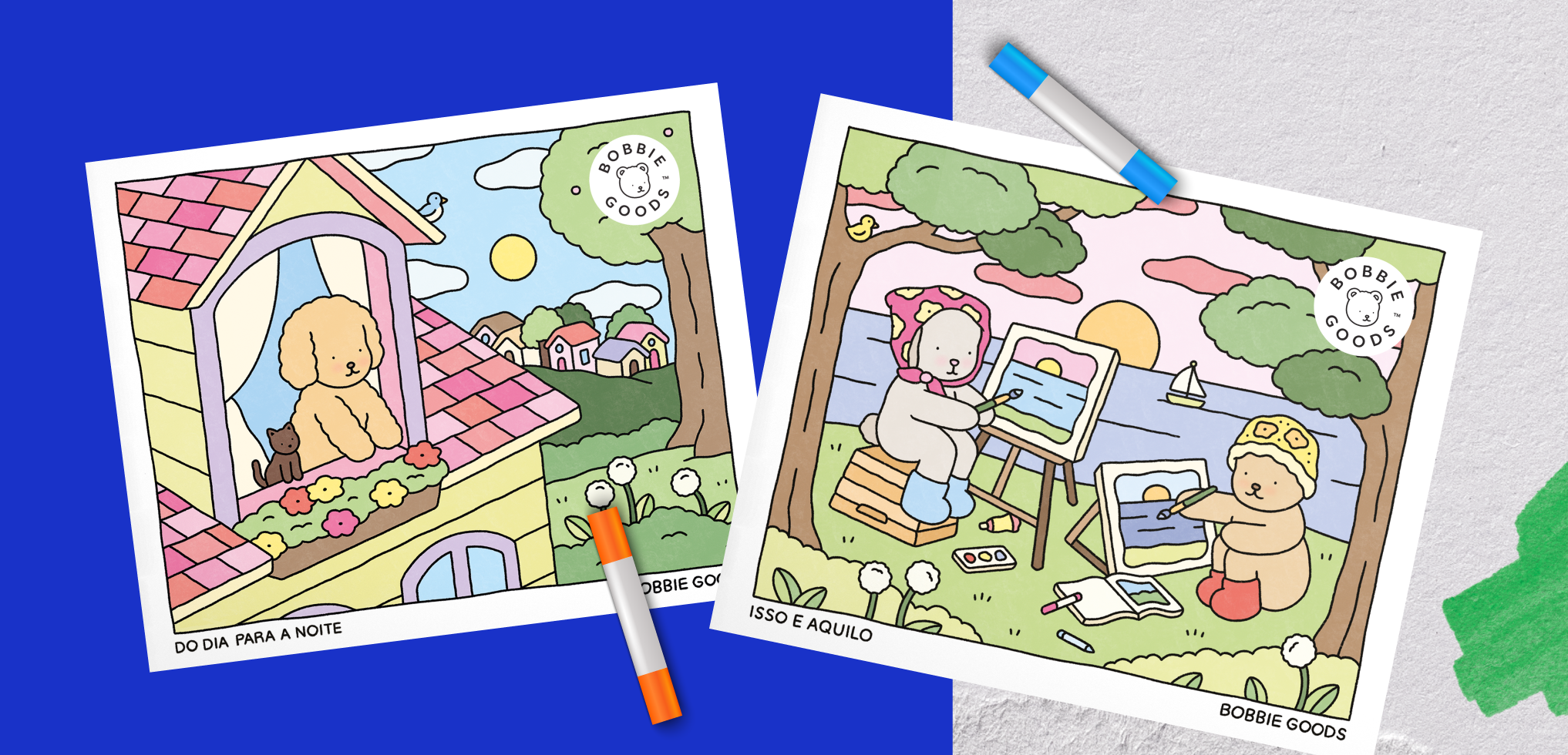
The fever is such that, in addition to bustling social networks with videos that reach millions of views, coloring books were responsible, in Brazil, for 11% of the total of 4.8 million copies sold in Brazil between March and April 2025, according to 5th Retail Book Panel in Brazil 2025, research conducted by Nielsen Book and published by the National Union of Book Publishers (SNEL). Globally, the coloring book market was valued at 150 million dollars in 2023 and is expected to reach 350 million dollars in 2031, according to the consultancy Verified Market Research.
Read more
5 reasons to recycle with children
Why do people search for coloring books?
We live in a digital age where screens are present at virtually every moment of the day. In this context, it is natural that analog activities are sought as an exhaust valve. “We can understand that it is a way for people to relax looking at the screens and handling something physical to return to sensations, such as smelling paper and seeing colors,” explains Edwiges Parra, psychologist, educator and founder of Emind Human Development and Mental Wellbeing.
Another explanation for the coloring book boom is the desire to find a distraction to relax. “It's 'I don't want to think about anything'. It's valid as long as I know why I'm looking for a coloring book and I understand that this is a fun and entertaining resource,” says Edwiges.
Read more
Discover Suzano's line of printing and writing papers
What are the benefits of coloring books?
The act of coloring may be associated with mental well-being. A study, conducted by the University of Otago in New Zealand in 2017, revealed that 10 minutes dedicated to the pastime helps to reduce symptoms of anxiety and depression and to increase the sense of mindfulness, or mindfulness.
“In a clinical context, the coloring book is a good distraction technique and leads to the perception of relaxation. When someone has anxiety and needs to deal with intrusive thoughts, for example, coloring can help divert attention to something else,” explains Edwiges.
Coloring books are also a good stimulus for other creative and analog activities, such as freehand drawing or writing a journal. “The brain is stimulated differently on paper. When we write by hand, our brain connects much more with words than when we do this activity on a computer or cell phone — in these tasks, the brain is concerned not to misspell,” says Edwiges.
Read more
Sustainable tourism: what it is and how to practice
Why should we dive into conventional books?
Although coloring books are a hobby that brings benefits, this hobby should be added to - and never replace - one of the most stimulating activities for mental health: reading paper books. Researchers at Macquarie University in Australia found that comprehension is more effective on paper than on screens, especially when the text requires deeper understanding or when people are in a hurry.
“Books are the brain academy,” says Edwiges. This is because immersing ourselves in novels, biographies, and poetry helps us to increase repertoire, vocabulary, images, sensations, and thoughts. “The text helps you reflect on your life, in addition to stimulating relevant cognitive functions such as learning, understanding, associating, and disagreeing,” explains the psychologist. “One author pulls the other and you expand your mind and your repertoire.”
Conclusion
The hobby of coloring books has benefits such as reducing anxiety and reconnecting with the physical world. After all, smelling the paper and focusing on finding the best colors for each drawing help slow down.
However, it is necessary not to restrict yourself to this hobby and also seek other analogical ways to relax and unleash creativity - such as drawing, writing by hand and reading books - to further stimulate mental health and expand intellectual capacity.
.svg)